
The launch is tentatively scheduled at 09.28 hrs IST on November 25, 2019 subject to weather conditions, ISRO said.

The 436-kg EMISAT and other satellites would be launched from the Satish Dhawan Space Centre in Sriharikota.

Following are some interesting facts about the 1,350-kg 'Mangalyaan' mission and its launch
India's ambitious Mars Orbiter Mission will send a spacecraft hurtling into space on a 400-million-kilometre journey that will last a year. The blast off is on Tuesday afternoon.

As many as 23 companies have evinced interest in acquiring the Indian space agency's Small Satellite Launch Vehicle technology, said a top official who termed it a "tremendous response". Chairman of Indian National Space Promotion and Authorisation Centre (IN-SPACe) Pawan K Goenka said on Thursday that they are keen to see how the private sector uses the Small Satellite Launch Vehicle (SSLV) technology. "There has been a tremendous response, 23 companies have (so far) shown interest in applying for this technology.
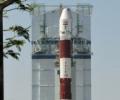
Indo-French oceanographic study satellite 'SARAL' and six foreign mini and micro spacecrafts were successfully launched on Monday by Indian Space Research Organisation's PSLV-C20 rocket from this spaceport.

GaneshUtsav has begun and social media is flooded with pictures of celebrities welcoming Lord Ganesha home.
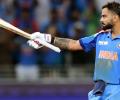
Virat Kohli bagged his fifth player of the match award against Pakistan in ICC tournaments including ODI/T20I World Cups and Champions Trophy -- the most by any player against a single opposition.
A round up of what's happening in the world of technology, gadgets and gizmos.
India's Polar Satellite Launch vehicle-C16 rocket on Wednesday successfully launched into orbit the latest remote sensing satellite Resourcesat-2 that would study and help manage natural resources along with two nano satellites.
The 51-hour countdown for India's landmark 100th space mission began on Friday with Indian Space Research Organisation's old warhorse Polar Satellite Launch Vehicle rocket all set to soar into space on September 9 with two foreign satellites from the spaceport of Sriharikota in Andhra Pradesh.
India's Polar Satellite Launch Vehicle on Wednesday successfully sent into orbit four satellites, including the Indo-French tropical weather satellite Megha-Tropiques.

Rehana Sultan was all set to be a path-breaker. The time was right. Hindi cinema had emerged from the 1960s musicals era. But somehow, leading film-makers of the time did not believe Rehana had that cachet. It was Zeenat Aman who ended up being the definitive taboo-trasher of the era. Dinesh Raheja salutes the trendsetter of the 1970s, Rehana Sultan.
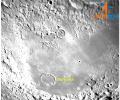
If any factor regarding the lander module appears unfavourable, then the landing will be shifted to August 27, said the Space Applications Centre-ISRO about Chandrayaan-3 on Monday.

The 1,858 kg spacecraft, the country's first microwave remote sensing satellite, was injected into orbit by the Polar Satellite Launch Vehicle about 19 minutes after a perfect lift off at 5.47 am at the end of the 71-hour countdown from the Satish Dhawan Space Centre, around 90 km from Chennai.

Indian Space Research Organisation has built a supercomputer, which is to be India's fastest in terms of theoretical peak performance of 220 TeraFLOPS (220 Trillion Floating Point Operations per second).
ISRO sources said that with Sunday's mission, the agency has launched 62 satellites, one space recovery module and 37 rockets, making it a grand 100

Producer Dinesh Vijan has worked with several film stars, and they all came together to party hard on his birthday.

Aditya-L1 is the first Indian space-based observatory that will study the Sun from a halo orbit around the first Sun-Earth Lagrangian point (L1), which is located roughly 1.5 million km from the Earth.

Punjab have never won the IPL since the league's inception in 2008 and the four co-owners will be hoping Australia's World Cup-winning captain takes them all the way.

The heaviest rocket of the Indian Space Research Organisation -- LVM3-M2/OneWeb India-1 -- blasted off from the Sriharikota spaceport on Sunday to place 36 broadband communication satellites into the Low Earth Orbit (LEO) for a UK-based customer.

Aditya L1, the first space based Indian mission to study the Sun underwent the second earth-bound manoeuvre successfully, during the early hours on Tuesday, Indian Space Research Organisation (ISRO) said.

The Indian Space Research Organisation on Sunday faced a blip in its plan to tap the small satellite launch vehicle market, as an anomaly in the placing of the satellites by the rocket led to deviation on its path thereby becoming 'no longer usable', Chairman S Somanath said on Sunday.
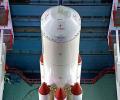
India on Friday successfully launched its latest communication satellite GSAT-12 onboard a powerful variant of homegrown Polar Satellite Launch Vehicle, PSLV-C17, from the spaceport in Sriharikota.

Former National Aeronautics and Space Administration (NASA) Official Mike Gold has said Chandrayaan-3's success is a triumph of Indian innovation, human capital and the capabilities that will take India even further.
India's ambitious attempt to flight-test its indigenous cryogenic engine on Thursday received a setback as the homegrown rocket Geosynchronous Satellite Launch Vehicle (GSLV-D3) deviated from path within seconds of lift-off.
Indian Space Research Organisation is all set for the launch of the first flight-testing of indigenous cryogenic engine on homespun rocket, Geosynchronous Satellite Launch Vehicle (GSLV-D3), from the Satish Dhawan Space Centre at Sriharikota at 4.27 pm on Thursday.
The Indian Space Research Organisation's Satish Dhawan Space Centre in Sriharikota will soon initiate the process of creating Third Launch Pad for human transportation into space, SHRC Director Chandra Datttan on Tuesday said during Republic Day celebrations.

ISRO chairman S Somanath said the success gave the space agency "greater confidence," as the GSLV will be next deployed in the NISAR mission, a collaborative effort with the US' NASA.
David and his son Rohit Dhawan look back at the exciting weekend.
The satellite will enable a full range of services to neighbours including the areas of telecommunication, television, direct-to-home, VSATs, tele-education and tele-medicine.
Launch of India's latest communication satellite GSAT-5P onboard homegrown GSLV-F06, powered by Russian cryogenic engine, failed on Saturday when the rocket developed a snag soon after lift-off from the spaceport in Sriharikota.
The final 52-hour countdown for the October 22 launch of the country's first moon mission, Chandrayaan-I, began early on Monday morning at the Satish Dhawan Space Centre at Sriharikota in Andhra Pradesh.

ISRO's first mission in 2023 and SSLV's sequel saw a strange coincidence--it was launched at 9.18 am, the same time its predecessor lifted off from the Satish Dhawan Space Centre here on August 7, 2022 but could not deliver due to orbit anomaly and flight path deviation.

The Indian Space Research Organisation on Wednesday placed in orbit seven satellites including Oceansat-2 within a span of 20 minutes, its first successful mission after the abrupt end of the ambitious Chandrayaan-I project.

'ISRO's style is a terrific example of being able to survive, acknowledge failures, and then most importantly of all, learn from them to ensure that subsequent missions are successful.'
The Polar Satellite Launch Vehicle PSLV-C15 carrying five payloads, including India's remote sensing satellite Cartosat-2B, successfully lifted off from the spaceport in Sriharikota on Monday.

Weighing 320 tonne at lift-off, the vehicle used larger strap-on motors to achieve higher payload capability.
For carrying the 360-kg Italian satellite, meant for astronomical studies, Indian Space Department's commercial wing Antrix Corporation would receive a fee from the Italian space agency.
The GSLV will put into orbit the INSAT-4CR, which carries 12 high-power Ku-band transponders for direct-to-home television services, video picture transmission and digital satellite news gathering.
